
Endgame
Palworld Breeding Guide 1.0 — Use the Calculator Without Wasting Cake
How 1.0 breeding changed, when to reverse-search parents, and how to share a combo with a link.
Use breeding when you need a specific worker, fighter, or mount. Check the result before assigning two pals so you do not spend cake and incubation time on a species you already own.
Before you light the ranch
- Stable food and cake production
- Beds and SAN management so parents actually work
- A clear target: species and role, not "something strong"
- Inventory space for eggs and failed hatches you will still use as workers
If any of these are missing, stabilize food and ore production first. A breeding farm consumes cake and worker time before it improves your team.
Mode A — Parents → Child
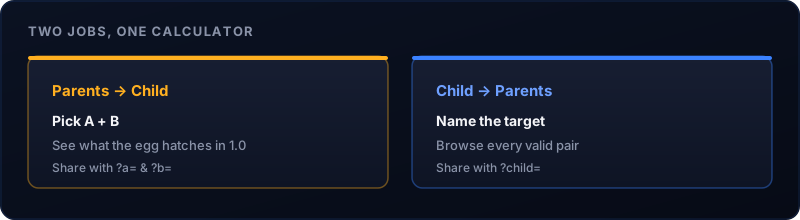
You already have two pals in the farm. Ask what the egg becomes before you wait the timer. This mode is for "I am about to commit these two — is the child useful?"
- Open the breeding calculator.
- Select parent A and parent B.
- Read the predicted child against your tier list and work needs.
- Copy the URL if the pair is a keeper for a friend or your second save.
Mode B — Child → Parents (the useful one)
You want a specific pal. Reverse lookup lists valid combinations so you can prefer parents you already own, parents that are easy to catch, or parents that sit on the way to a longer chain.
- Decide the target species (example: a work specialist or a combat core).
- Open reverse lookup and search the child.
- Prefer combinations whose parents you already own or can capture in your current region.
- Check the child's Paldeck page for work levels, partner skill, and tier badges before you commit a long chain.
How to pick targets that matter
Choose the target by the job you need
| Job | Where to look | Then breed toward |
|---|---|---|
| Tower / boss DPS | Combat tier list | A species that covers the next boss element |
| Ore / production | Work tier list + Paldeck work ranks | High Mining / Handiwork lines you will actually assign |
| Travel | Mounts tier list | A mount you will saddle and keep on the party |
| Capture support | Catching role list | Helpers that make the next Alpha cheaper |
Chain discipline
Long chains fail when every step is "maybe." Write the end species first. Then only keep intermediate parents that either (1) you already own, or (2) drop naturally while exploring. If a step requires a rare you do not have, catch or buy that rare before you start incubating the rest.
Passives and "one more egg"
Species first, then passives. A perfect passive stack on the wrong worker still sits in the box. Hatch for the species and role you need, keep the best work or combat individuals, and only then burn cake chasing a prettier passive line.
After the hatch
- Open the pal's Paldeck page and confirm work ranks / partner skill
- Drop fighters into Team Builder and check coverage
- Assign workers immediately — unassigned "future legends" clog the box
Pitfalls
- Following a pre-1.0 Anubis (or any) recipe without recalculating
- Breeding legendaries before you can feed the farm
- Optimizing passives while your ore base is still empty
- Keeping twenty "maybe" eggs and zero assigned miners
Guide FAQ
Did Palworld 1.0 change breeding results?
Yes. The breeding table was rewritten. Many Early Access parent pairs hatch something different now, so recalculate targets instead of trusting old spreadsheets.
Should I use Parents → Child or Child → Parents?
Use Parents → Child when you already own two pals and want to know the egg. Use Child → Parents when you know the target and need every valid pair.
Can I share a breeding combo?
Yes. The calculator writes ?a= and ?b= for parents, or ?child= for reverse lookup, into the URL.
When is breeding worth doing?
After you can feed a farm (cake, ranch space, time). Breeding before a mining base usually stalls both projects.
Do legendary pals follow the same rules?
Most pairs follow the catalog math. Some legendaries and unique lines have extra constraints — if a result looks wrong, open that pal's detail page and re-check the pair list.